Using Betting Exchanges for F1: Laying, Trading and the In-Play Edge
 Available in US
The Tool That Turns Betting Into Trading
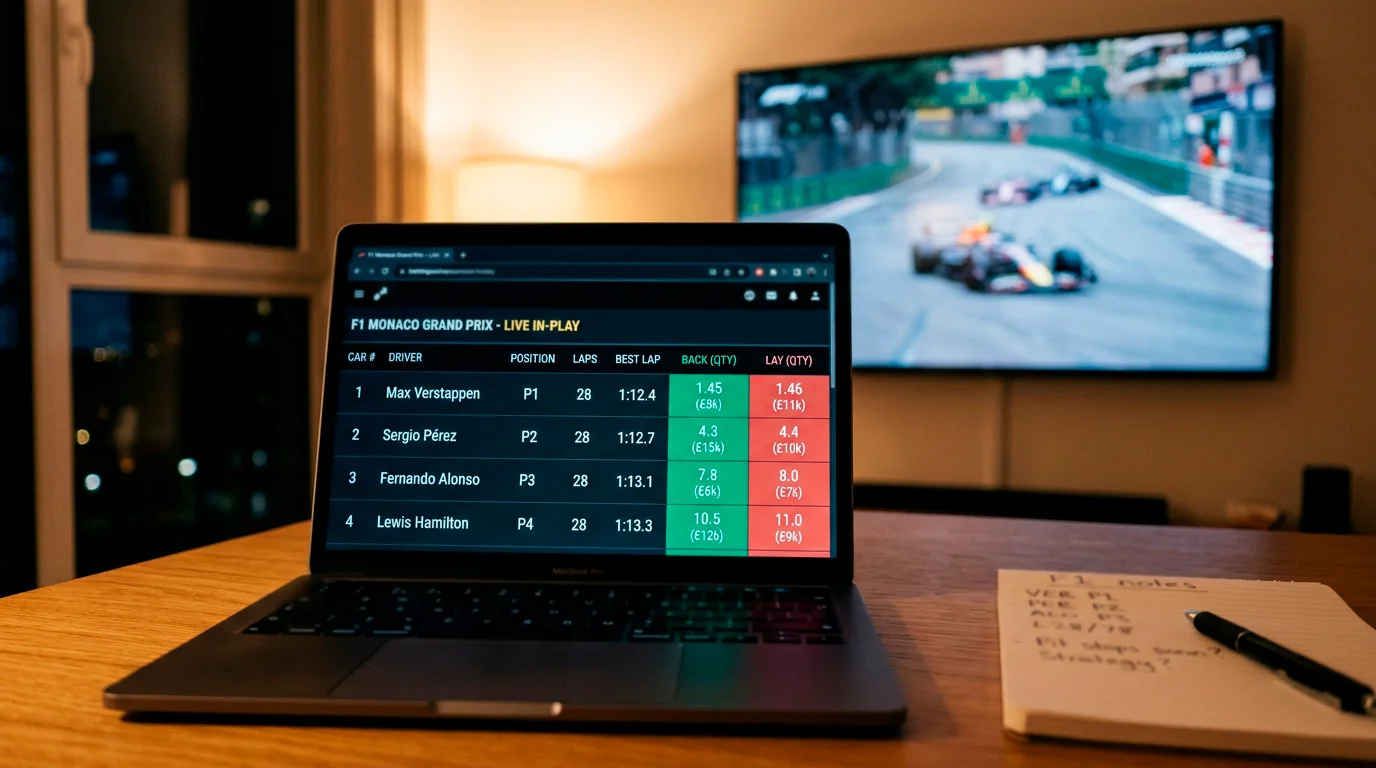
The first time I placed a lay bet on an F1 race — betting against a driver rather than for them — it felt like discovering a second dimension in a world I thought was flat. Traditional bookmakers offer you one option: back a selection to win. Exchanges offer two: back or lay. That duality changes the entire strategic landscape of F1 betting, and the bettors who operate on both sides of the market have a structural advantage over those who only back.
Betting exchanges work like financial markets. Every bet has a buyer and a seller. When you back a driver at 5.0 on the exchange, someone else is laying that driver at 5.0. The exchange takes a commission on winnings (typically 2-5 per cent) rather than building margin into the odds, which means exchange prices are consistently sharper than traditional bookmaker prices. F1 accounts for just 0.4 per cent of the global betting handle, but the exchange liquidity on headline F1 markets — race winner, qualifying, championship futures — is substantial enough for meaningful trading.
See also: explore betting f1 for the best F1 platforms.
Laying in F1: When and Why to Bet Against a Driver
Not every F1 bet needs to be a backing bet. Sometimes the most profitable position is opposing a driver whose odds are too short. I have found that laying the race favourite in F1 is a positive-expectation strategy at specific circuit types — particularly at street circuits where the safety car rate exceeds 70 per cent. The favourite’s implied win probability at those venues is typically priced around 35-40 per cent, but the combination of safety car risk, first-lap incident probability, and strategy variance pushes the true win probability below that level. A lay at 2.8 (implied 35.7 per cent) on a driver whose true win probability is 30 per cent is a simple edge that repeats across the calendar.
Laying also works well in the head-to-head market. If you believe a bookmaker’s H2H pricing is wrong — say, the favourite is priced at 1.5 when your data says the true probability is 55 per cent rather than the implied 66.7 per cent — laying the favourite on the exchange at 1.5 gives you a positive-expectation position without needing to back the other driver. This is useful when you have a view against one driver but are not confident enough in the alternative to back them outright.
Trading the Race: Backing and Laying for Green-Book Positions
Here is where exchanges transform F1 betting from a punt into an activity with genuine risk management. Trading means backing a selection at one price and then laying it at a shorter price (or vice versa), locking in a profit regardless of the outcome. In F1, the price movements during a race weekend are large enough to create genuine trading opportunities.
The classic F1 trade is the qualifying lock. Before qualifying, you back a driver at their pre-weekend price — say, 8.0 to win the race. After a strong qualifying session puts them on pole, the race winner price shortens to 3.5. You lay at 3.5, locking in a profit spread across all outcomes. The qualifying result moved the price, and you captured the movement. The 43 per cent of F1 fans who are under 35 have grown up with exchange trading in other markets and transfer that mindset naturally to motorsport.
In-play trading takes this further. During the race, prices fluctuate with every safety car, pit stop, and position change. A driver running third whose odds are 6.0 to win might shorten to 3.0 after a safety car bunches the field and they emerge right behind the leader. That 6.0-to-3.0 movement is a tradeable swing, and if you backed at 6.0 pre-safety-car, laying at 3.0 locks in profit. The skill is anticipating which events will cause price movements and being positioned before they happen.
Exchange Liquidity in F1: Where the Money Is and Where It Is Not
Exchange liquidity is the practical constraint. The race winner market at a headline Grand Prix — Monaco, Silverstone, the season opener — carries enough liquidity for bets in the hundreds of pounds. At a less glamorous mid-season race, the liquidity thins. Qualifying markets and head-to-head markets carry less liquidity than the race winner. Prop markets (fastest lap, safety car, margins) may have minimal exchange presence.
Low liquidity is not always a disadvantage. In thin markets, the available prices are set by a smaller number of participants, and those participants are not always sharp. A mispriced lay offer on a qualifying market might sit unmatched for 10 minutes before someone takes it, giving you time to assess and execute. In deep-liquidity markets, mispricing is corrected in seconds. For patient bettors who do not need instant execution, the less liquid F1 exchange markets can offer better value than the headline race winner market.
UK betting participation reached 12 per cent of adults in the most recent data wave, and the exchange share of that participation is growing as bettors become more sophisticated. F1’s appeal to the exchange market is its event structure — a race weekend spans three days with multiple betting events (practice, qualifying, sprint, race), each of which triggers price movements that can be traded. No other sport offers the same density of information-driven price catalysts across a single weekend.
Combining Exchange Positions With Traditional Bookmaker Bets
The sharpest F1 bettors do not choose between exchanges and traditional bookmakers — they use both. The bookmaker offers promotional value (free bets, acca boosts, enhanced odds) that the exchange does not. The exchange offers laying, trading, and sharper base prices. Combining the two creates a toolkit that covers every market condition.
See also: claim bonus offers with our F1 free bet offers guide.
A practical example: you identify value on a driver at 10/1 at a traditional bookmaker, which is paying two places at 1/4 odds each-way. You back each-way at the bookmaker. Simultaneously, you lay the same driver at the exchange at a shorter price — say, 9.0 — for a stake calculated to lock in a small profit if the driver wins and reduce the downside if they do not. The each-way place portion at the bookmaker is your insurance, and the exchange lay is your risk management. The combined position has a higher expected value than either bet in isolation, and the variance is lower because you have hedged across platforms.
This cross-platform approach works particularly well during the qualifying-to-race repricing window. Back a driver at the bookmaker before qualifying when the odds are widest, then lay on the exchange after a strong qualifying result compresses the price. The bookmaker bet provides the initial upside; the exchange lay captures the qualifying premium without closing the bookmaker position.
What is a lay bet in F1 exchange betting?
A lay bet means you are betting against a selection — you profit if the driver does not win. On a betting exchange, when you lay a driver at 5.0, you are accepting the risk of paying out if they win (4 times the backer’s stake) in exchange for collecting the backer’s full stake if they lose. Laying is useful in F1 when you believe a driver’s odds are too short relative to their true win probability, particularly at high-variance circuits where safety cars and strategy reduce the favourite’s advantage.
How do you trade an F1 race on a betting exchange?
Trading involves backing a selection at one price and laying it at a different price to lock in a profit regardless of the outcome. The classic F1 trade is backing a driver before qualifying at wide odds and laying after a strong qualifying result compresses the price. In-play trading captures price movements during the race caused by safety cars, pit stops, and position changes. The exchange commission (typically 2-5 per cent) is deducted from net winnings.
Created by the ”Betting f1” editorial team.