F1 Bet Builder Strategy: Combining Markets on a Single Race
 Available in US
What a Bet Builder Actually Does — and Why F1 Suits It
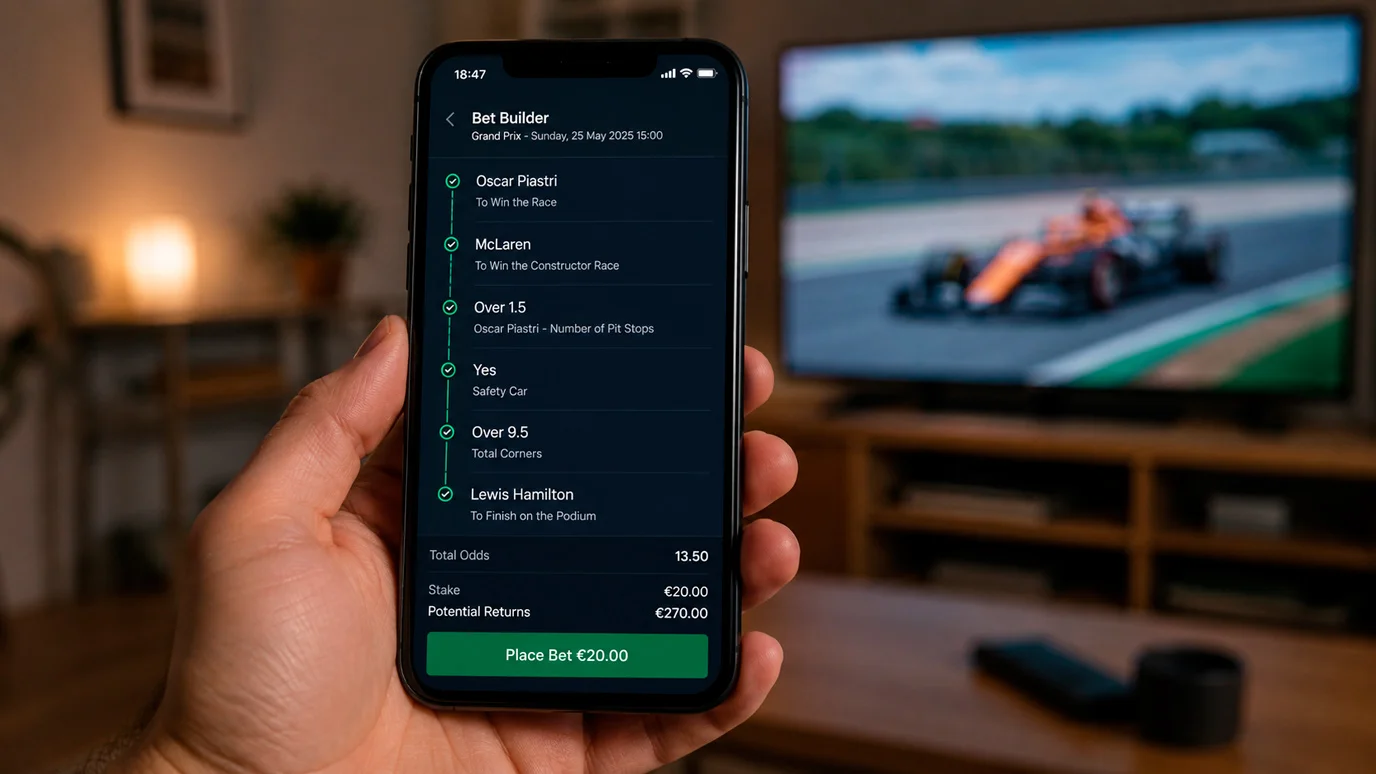
The first time I used a bet builder for an F1 race, I combined three legs that all seemed like near-certainties and still lost. That experience taught me something crucial: a bet builder is not a way to stack safe picks for a bigger payout. It is a tool for expressing a specific race thesis — a narrative about how a Grand Prix will unfold — in a single wager.
A bet builder lets you combine multiple selections from the same event into one bet, with the odds multiplying across each leg. In football, this might mean combining a match result with a goalscorer and a card count. In F1, the combinations are richer because a Grand Prix produces dozens of measurable outcomes: race winner, podium finishers, fastest lap, safety car appearances, retirement count, head-to-head driver battles, and position-based props. The sport’s complexity is what makes bet builders so compelling here — you can construct wagers that reflect genuine analytical insight rather than just stacking favourites.
F1’s growing profile helps too. The global fanbase reached 827 million in 2025, and bookmakers have responded by expanding their race-day menus to feed demand. Five years ago, you might have found six or eight markets per Grand Prix. Now the major operators list thirty or more, and bet builders draw from the full menu. That depth is your canvas.
See also: check betting f1 for top F1 multi-bet options.
Selecting Legs That Tell a Coherent Story
Here is where most people go wrong: they pick legs independently, choosing what they think will happen in each market without considering how those outcomes connect. A good bet builder is a story, not a shopping list. Every leg should reinforce the same race scenario.
Say your thesis for the Hungarian Grand Prix is that Red Bull’s straight-line speed advantage will be neutralised by the Hungaroring’s tight, twisting layout, letting the high-downforce McLaren package shine. A coherent bet builder might combine a McLaren driver to win, a Red Bull driver to finish outside the top three, and under 1.5 safety cars — because a processional race at a track with limited overtaking suits the car that qualifies at the front. Each leg flows from the same underlying logic.
Now contrast that with a random combination: McLaren to win, most pit stops for a Williams driver, and a safety car in the first ten laps. These legs have no relationship to each other. The safety car prediction does not follow from your McLaren thesis, and the pit stop selection is pure noise. Even if each leg has positive expected value in isolation, the combination does not represent an analytical position — it is just multiplication of probabilities.
I build every bet builder around a central thesis and then ask myself: if this thesis is correct, what else must be true? The answers become my legs.
Managing Correlation: The Hidden Trap in Multiplied Odds
Correlation is the concept that separates sharp bet builder users from everyone else. Two outcomes are correlated when the occurrence of one changes the probability of the other. In F1, correlation runs deep. If a safety car is deployed, the probability of a different race winner increases because the field bunches up. If it rains, the probability of retirements rises. Bookmaker models account for some of this correlation when pricing bet builders, but not always perfectly — and that imperfection is where value lives.
Positive correlation between your legs is your friend when the bookmaker underprices it. If you combine “wet race” with “more than two retirements” and the builder prices these as if they were independent events, you are getting better odds than the true probability warrants. Rain genuinely does cause more retirements — cars aquaplane, drivers misjudge braking points, visibility drops. The correlation is real, and if the price does not reflect it, you have an edge.
Negative correlation is the trap. Combining a driver to win with the same driver to set the fastest lap seems logical — the winner is usually quick, right? But the fastest lap often goes to a driver on fresh tyres late in the race who pits specifically to chase it, and that driver is rarely the leader protecting a gap out front. The legs pull against each other, and the multiplied odds overstate the combined probability of both landing. I actively avoid combinations where success in one leg makes the other less likely, unless the odds compensate generously for that tension.
Sizing and Staking: Treating Builders as Speculative Bets
A three-leg bet builder at combined odds of 12.00 is not the same proposition as a single bet at 12.00. The single bet has one point of failure; the builder has three. This distinction should govern your staking. I treat bet builders as speculative positions — they sit in the portion of my bankroll reserved for higher-risk, higher-reward plays, never in the core allocation.
My rule of thumb: no bet builder receives more than 1% of my race-weekend bankroll, regardless of how confident I feel about the thesis. The hit rate on three-leg builders, even good ones, tends to hover around 8-12% over a season. That means you need 10 to 12 attempts to expect a single winner, and the winners need to pay enough to cover the losing streak plus profit. Flat staking keeps the variance manageable. If you scale up on “certainties,” you are one bad pit stop away from blowing through your monthly allocation.
Track your builders separately from your straight bets. After a full season, review the hit rate by number of legs, by market type, and by circuit. You will find patterns — maybe your qualifying-position legs hit at a higher rate than your fastest-lap legs, or maybe wet-race builders outperform dry ones. That data shapes next season’s approach.
Circuits and Contexts Where Bet Builders Thrive
Not every Grand Prix is a good bet builder race. The tool works best when the event has clear, analysable characteristics that translate into multiple correlated outcomes. Street circuits like Monaco, Singapore, and Jeddah are prime candidates because their narrow layouts produce predictable patterns — fewer overtakes, more safety cars, qualifying position carrying outsize importance. Your thesis translates cleanly into multiple legs because the circuit dictates the race narrative.
See also: build bigger returns with our F1 accumulator tips article.
High-degradation races are another sweet spot. When tyre wear forces strategic variety, you can build combinations around pit-stop windows and position changes that reward detailed preparation. With 43% of F1 fans under 35 and bet builders disproportionately popular among younger demographics, bookmakers invest heavily in these markets for flagship events, which sometimes means promotional odds boosts on builders that further tip the value equation in your favour.
Races with unpredictable elements — mixed weather forecasts, new circuits, sprint weekends — are trickier. More uncertainty means your thesis is less reliable, which undermines the coherent-story approach. I scale down my builder stakes for these events and keep the leg count to two rather than three, reducing the points of failure while still expressing a directional view. For more on how to structure accumulator-style wagers across multiple selections, the principles of leg selection and correlation management translate directly.
How many legs should an F1 bet builder have?
Two to three legs is the practical sweet spot. Each additional leg multiplies the odds but also multiplies the ways your bet can lose. Beyond three legs, the hit rate drops so sharply that even attractive combined odds struggle to deliver positive returns over a full season.
Do bookmakers adjust bet builder odds for correlated outcomes?
Most major bookmakers apply correlation adjustments that reduce the combined odds when legs are positively linked — for example, combining a driver to win with the same driver to lead the most laps. However, these adjustments are not always perfectly calibrated, and finding mispriced correlations is where informed bettors can find genuine value.
Can I use a bet builder for qualifying as well as the race?
Some bookmakers offer bet builders that span the full weekend, including qualifying position markets and sprint results alongside race outcomes. Check whether the builder tool on your chosen platform supports cross-session combinations, as availability varies between operators.
Published by the Betting f1 team.