Circuit-Specific F1 Betting: How Track Profiles Shape Odds and Outcomes
 Available in US
Every Circuit Tells a Different Betting Story
I keep a spreadsheet that maps every circuit on the F1 calendar against five key characteristics: overtaking rate, pole-to-win conversion, safety car frequency, tyre degradation level, and average winning margin. That spreadsheet is the single most useful betting tool I own, because it tells me which markets to target at each venue before the weekend even starts. A circuit is not just a track layout — it is a probability engine that generates predictable patterns in race outcomes, and those patterns translate directly into betting edges.
The 2026 calendar spans 24 races across purpose-built circuits, street tracks, and hybrid layouts. Each category behaves differently in the betting markets, and treating them as interchangeable is the fastest way to bleed money over a season. The bookmakers price each race weekend individually, but their adjustments for circuit characteristics are often generic — a slight tightening of the favourite’s odds at Monaco, a slight loosening at Monza. The real data is more nuanced than that, and the gaps between the bookmaker’s generic adjustment and the circuit-specific reality are where the value lives.
See also: browse betting f1 for comprehensive F1 analysis.
Power Circuits: Where Straightline Speed Decides Bets
Monza, Spa, and Baku’s long-straight sections are the defining power circuits on the calendar. These tracks reward engine performance and low-drag aerodynamic setups, which means the teams with the strongest power units tend to outperform their season-average grid position at these venues. The average F1 Grand Prix draws 76.1 million viewers, and power circuits consistently generate some of the closest racing because DRS zones and slipstreaming create genuine overtaking opportunities.
For betting, power circuits produce two distinctive patterns. First, the pole-to-win conversion rate is lower than at downforce-dependent circuits — typically 50-55 per cent compared to 70-80 per cent at tracks like Monaco or Singapore. That lower conversion rate means the pole-sitter is overpriced as race winner more often at power tracks, and the driver starting second or third carries more value than the headline grid position suggests. Second, the overtaking rate is higher, which means head-to-head matchups between drivers starting out of position (due to grid penalties or poor qualifying) are less predictable. A driver starting tenth with a fast car can realistically finish fifth at Monza. At Monaco, that same driver might finish ninth.
The practical angle: at power circuits, weight your analysis towards race pace rather than qualifying pace, back the faster car over the better qualifier in H2H markets, and look for value on drivers who took grid penalties but have the straight-line speed to recover positions.
Street Circuits: Qualifying Is the Race
Monaco was the race that taught me to respect the circuit profile. I backed a driver with strong race pace but a fifth-place qualifying position, assuming the pace would show through. He finished fifth. Overtaking at Monaco is functionally impossible unless the car ahead makes a mistake or pits, and that structural reality turns qualifying into the race itself.
Street circuits — Monaco, Singapore, Jeddah, Baku (partially), and Las Vegas — share narrow tracks, concrete barriers, and limited runoff. The 6.7 million spectators who attended F1 events in 2025 include the spectacular crowds at these venues, drawn by the spectacle of cars threading through city streets. For bettors, street circuits produce the highest pole-to-win conversion rates on the calendar, the highest safety car probabilities, and the lowest overtaking rates. Each of those patterns creates specific market edges.
The qualifying market at street circuits is the primary betting event. If your analysis identifies the fastest driver in qualifying trim, the race winner bet is essentially a qualifying bet with a safety-car-risk discount. The safety car “yes” market is consistently underpriced at street circuits where the historical deployment rate exceeds 80 per cent. And each-way bets lose much of their value because the podium order tends to be set by qualifying position rather than race-day variance — backing a tenth-place qualifier for a podium finish is a much longer shot at Monaco than at Silverstone.
High-Downforce vs Low-Downforce Setups and Their Market Implications
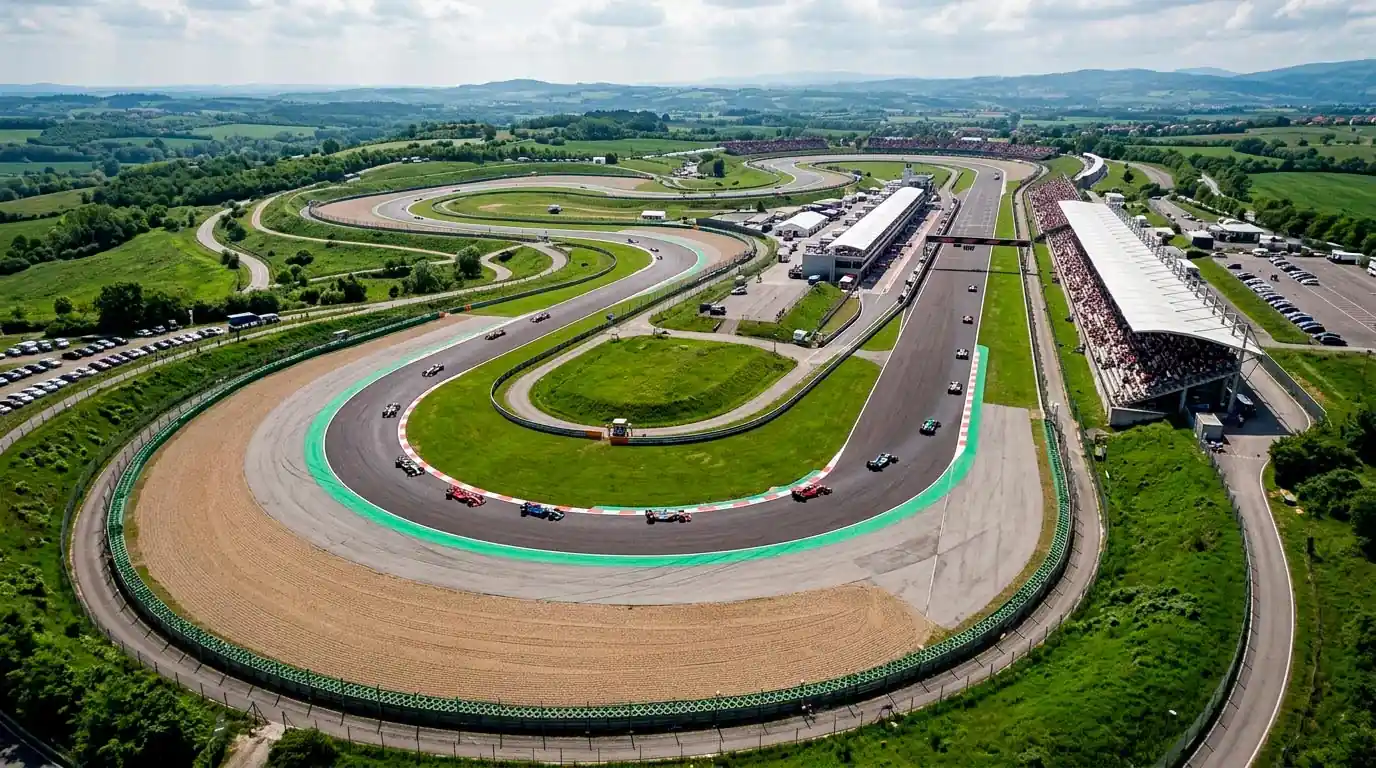
The car setup a team chooses for a specific circuit tells you something the odds might not. High-downforce tracks — Hungary, Barcelona, Zandvoort — reward mechanical grip and cornering speed. The teams with the best chassis and aerodynamic platform tend to dominate at these venues regardless of power unit performance. Low-downforce tracks reward engine power and straight-line efficiency.
This setup distinction matters for constructor matchup betting. A team might be third in the constructors’ championship on overall pace but first at high-downforce circuits because their car generates more cornering load. Backing that team in constructor H2H markets at Budapest or Barcelona is a repeatable seasonal edge. Conversely, a team with a strong engine but an aerodynamically compromised chassis will overperform at Monza and underperform at the Hungaroring. Mapping each team’s setup strengths to the circuit calendar creates a 24-race playbook that the bookmakers do not explicitly price.
Tyre degradation adds a layer to the setup picture. High-degradation circuits like Bahrain and Austin punish cars that are hard on their rear tyres, which often correlates with high-downforce setups that load the rear axle. The fastest car in qualifying might not be the fastest car after 30 laps on the same set of tyres, and the strategy-aware bettor who tracks degradation rates from practice long runs will spot this divergence before the race starts.
Seasonal Patterns: How Circuit Clusters Affect Multi-Race Betting
The F1 calendar is not randomly sequenced. Triple-headers and back-to-back races create circuit clusters where the same team strengths carry over from one weekend to the next. The Middle Eastern swing (Bahrain, Saudi Arabia, sometimes Qatar) favours power-unit performance. The European summer run (Spain, Austria, Britain, Hungary) tests the full spectrum of car characteristics. The Asian stretch (Singapore, Japan, sometimes China) often brings weather variability.
See also: factor in rubber degradation with our F1 tyre strategy betting article.
These clusters matter for accumulator building and season-long market positioning. If a team shows strong pace at the first race of a cluster, the probability that they perform well at the remaining cluster races is higher than the independent probability of each race would suggest. The bookmakers adjust partially for recent form, but they rarely apply a circuit-cluster premium that fully captures the correlation. A driver who wins in Bahrain is likely to be in the top three at Jeddah a week later — not because of momentum but because the car characteristics that work at one venue work at the other. That correlation is a structural edge for multi-race accas.
The flip side: the transition between circuit types within a cluster is where form reversals happen. A team that dominated the high-downforce European circuits can struggle when the calendar moves to a power-sensitive venue. The odds on the previous cluster’s dominant team tend to be shorter than justified at the first race of a new circuit type, because the market is anchored to the most recent results rather than the circuit-specific historical data.
Which F1 circuits are best for each-way betting?
Power circuits with high overtaking rates — Monza, Spa, and Baku — offer the best each-way value because the probability of a midfield driver finishing on the podium is higher than at street circuits. The pole-to-win conversion is lower, grid penalties are less damaging, and strategic overtakes are common. Street circuits like Monaco and Singapore are the worst for each-way bets because the top-three order is largely determined by qualifying position, leaving little room for race-day surprises.
How does circuit type affect F1 safety car betting odds?
Street circuits produce safety cars at rates above 80 per cent over recent seasons due to narrow tracks and concrete barriers. Traditional circuits with gravel traps and wide runoff sit closer to 35-40 per cent. The bookmakers set a season-average baseline and adjust partially for circuit type, but rarely match the full historical rate. Checking the five-year safety car history at each venue before the weekend and comparing it to the bookmaker’s implied probability is the core edge in this market.
Created by the ”Betting f1” editorial team.