F1 Betting Strategy: Data-Driven Approaches That Outperform Gut Instinct
 Available in US
- Why Most F1 Bettors Lose — and How Data Changes That
- Bankroll Management for a 24-Race Season
- Exploiting the Qualifying-to-Race Gap
- Finding Value: When Odds Misprice a Driver
- Accumulator Strategy: Correlated and Uncorrelated Legs
- Weather, Tyre Degradation and Variable-Driven Edges
- Seasonal Arcs: Early-Season Value vs Late-Season Certainty
- Questions About F1 Betting Strategy
Why Most F1 Bettors Lose — and How Data Changes That
I tracked every F1 bet I placed during my first full season of serious wagering. At the end of twenty-two races, my strike rate on race winner bets was 9%. My overall return was negative 23%. I was picking drivers I liked, at circuits I enjoyed watching, with stakes that varied based on nothing more than how confident I felt on a given Sunday. That is not a strategy. That is entertainment with a receipt.
The turning point came when I started treating F1 betting the way the teams treat car development: measure everything, test assumptions against data, and accept that gut instinct is a starting point, not a conclusion. The numbers support this shift. 58% of motorsport bettors are aged 18-34 — a demographic that grew up with data dashboards and analytics tools — yet only 22% of F1 fans who bet have actually wagered on motorsport in the past twelve months. That disconnect tells me the product is there, the audience is there, but the approach most people take is still stuck in the “back your favourite driver” phase.
This guide lays out the strategies I use across a full 24-race season: bankroll management, qualifying-to-race edge exploitation, value identification, accumulator construction, weather-driven edges and seasonal timing. None of them require insider knowledge. All of them require discipline.
See also: visit betting f1 for a full library of F1 guides.
Bankroll Management for a 24-Race Season
A football bettor might have forty or fifty meaningful matches to wager on in a season. An F1 bettor has 24 Grands Prix, six sprint weekends and qualifying sessions for each — roughly seventy to eighty distinct betting events across the year. That volume changes how you should think about bankroll allocation.
I dedicate a fixed annual amount to F1 betting and divide it into units. Each unit represents a standard bet size. For race-weekend markets, I rarely exceed two units on a single position. For season-long outrights, I might go to three or four units on a position I have high conviction in, because the holding period is longer and the information advantage at the time of placement is typically stronger.
The mistake I see most often — and the one I made myself for years — is loading up on the first few races of the season out of excitement, then having nothing left when genuine value appears in the middle or back end of the calendar. Betting participation in the UK rose three percentage points to 12% of adults wagering in the most recent measurement period. More people are betting, which means more money flowing through the markets, which means odds can be sharper but also more reactive to public sentiment. A disciplined bankroll ensures you can act when the public overreacts to an early-season result.
My allocation splits roughly like this: 30% on season-long outrights placed before or during the first four races. 50% spread across race weekends in standard-size bets. 20% held in reserve for mid-season opportunities — regulation-driven odds shifts, driver transfers, or injury situations that create sudden value. That reserve fund has been the single biggest contributor to my positive seasons. Not because I am smarter about those situations, but because I have the capital available to act when they appear.
One more thing: set a loss limit per race weekend. I cap mine at five units. If a Friday practice accident or a freak qualifying result wipes out my pre-race positions, I do not chase on Sunday by doubling my stakes. The next race is never more than two weeks away. The calendar is your friend — it gives you plenty of chances to recover over the season, provided you do not burn through your bankroll trying to recover from a single bad weekend.
Staking plans are personal, and there is no universal formula. What matters is that the plan exists, that it is written down before the season starts, and that it includes explicit rules for when to increase exposure and when to pull back. The most dangerous weeks in an F1 bettor’s calendar are the ones immediately after a big win — the urge to press when you are running hot leads to oversized positions and inevitable regression. Flat staking, or something close to it, keeps the variance manageable and the bankroll intact for the races that actually matter.
Exploiting the Qualifying-to-Race Gap
Here is something that took me far too long to learn: qualifying results and race results are correlated, but they are not the same thing. The correlation varies massively by circuit, and the gap between qualifying performance and race pace is where some of the most consistent value in F1 betting lives.
At Monaco, qualifying is almost everything. The track is narrow, overtaking is rare, and the driver who starts on pole converts to a win at rates above 60% in recent eras. The qualifying-to-race gap is tiny. But at a circuit like Bahrain or Shanghai, where tyre degradation is high and overtaking is common, a driver starting fifth with superior race pace can realistically win. The qualifying-to-race gap is wide, and the market often does not fully adjust for it.
I build a simple spreadsheet each season tracking three things for every driver at every circuit: qualifying position, finishing position, and the delta between them. After three or four seasons, the patterns become unmistakable. Some drivers consistently outperform their grid slot — they are brilliant on race day, manage tyres well, overtake decisively. Others peak in qualifying and fade during races, losing positions through poor starts or degradation.
The practical application is straightforward. After qualifying, when race winner odds are freshly set, I look for drivers whose grid position understates their likely race performance at that specific circuit. A driver qualifying fourth at a track where they have historically gained two positions on average is not a fourth-favourite — they are probably a second or third favourite if you weight race pace correctly. If the bookmaker’s odds still price them as a mid-field shot, that is a value bet.
The reverse also works. A driver who qualifies brilliantly but consistently drops positions during races at high-degradation circuits can be worth laying on an exchange or avoiding entirely in win markets, even when their short odds look tempting after a front-row start. The market loves a good qualifying lap. I prefer good race data.
Finding Value: When Odds Misprice a Driver
Finding value is not about finding winners. That distinction confuses more bettors than anything else I encounter. Value exists when the odds offered imply a lower probability of the outcome than you believe is correct. A driver at 10/1 who you assess as having a 15% chance of winning is a value bet — even though they will lose 85% of the time.
The average Grand Prix audience in 2025 hit 76.1 million viewers — the highest since 2020. Millions of those viewers form opinions about who will win the next race based on what they just watched. When a driver dominates a weekend, the public piles in for the following race, and the bookmaker shortens the odds accordingly. That public money creates value elsewhere in the market. The driver who finished fourth but had the fastest race pace on used tyres might be 8/1 for the next race when a fair price is closer to 5/1 — but nobody noticed because the camera was following the winner.
I assess value by building my own implied probability for each race. This is not as complicated as it sounds. I assign rough percentage chances to each driver in the race winner market based on qualifying pace, race pace data, circuit characteristics and team form. I then convert those percentages to odds and compare them against what the bookmakers offer. Where the bookmaker’s odds are significantly more generous than my assessment, I have a candidate for a value bet.
The key word is “significantly.” A tiny discrepancy — 0.5% in implied probability — is noise. Bookmakers have sophisticated models and plenty of data. But discrepancies of 3-5% or more do appear regularly in F1, particularly for midfield drivers where the bookmaker’s attention and model accuracy are weaker. The front of the grid is priced efficiently because everyone is watching. The midfield is where the pricing gets lazy, and that is where I focus my race-day value hunting.
There is a secondary dimension: market-specific value. A driver might be fairly priced in the race winner market but underpriced in the podium market because the bookmaker’s model does not fully account for their consistency. Or a constructor might be fairly priced in the championship outright but mispriced in a specific race weekend’s constructor points market because of a track-specific advantage. The more markets you monitor, the more surfaces you have for value to appear.
Timing matters too. Odds on a race weekend open on Tuesday or Wednesday at most bookmakers, based on the previous race’s form and general expectations. By Friday evening, practice session data has reshaped the picture. I place roughly a third of my race-weekend bets pre-practice (when odds are based on stale information and occasionally generous) and two-thirds after Friday practice (when I have fresh data to compare against the available prices). The pre-practice bets are higher variance but capture the biggest mispricings; the post-practice bets are more informed but the odds have already adjusted. Splitting between the two windows diversifies my approach within a single weekend.
Accumulator Strategy: Correlated and Uncorrelated Legs
Accumulators are seductive and dangerous in equal measure. The payouts look extraordinary on paper, and the temptation to string together five or six “obvious” selections across a race weekend is strong. But every additional leg multiplies not just the potential return but the probability of failure. I use accas selectively, and the distinction that matters most is between correlated and uncorrelated legs.
Correlated legs are selections that depend on similar underlying outcomes. If you back Driver A to win the race and also include “Driver A fastest lap” in your acca, those two outcomes are positively correlated — a driver who wins is more likely to have the fastest lap. The bookmaker prices each leg independently, so the combined odds may overstate the true risk. That correlation is your edge. An acca built around correlated legs has a higher expected value than one built from random selections at the same headline odds.
Uncorrelated legs are independent outcomes. Backing a race winner and also betting on a safety car deployment are largely uncorrelated — the safety car does not much care who is leading. An acca mixing uncorrelated legs does not benefit from correlation, so the headline odds are a more accurate reflection of the actual probability. That does not make them bad bets, but the expected value advantage disappears.
My practical approach: I limit F1 accas to three or four legs. Beyond that, the compounding probability of failure makes the expected value negative regardless of correlation. I build race-weekend accas around a narrative — a single hypothesis about how the race will unfold — and pick legs that are consistent with that narrative. If I think a specific team will dominate, I might combine their driver to win, fastest lap for their other driver, and under 1.5 safety cars (because dominant races tend to be processional). That is a correlated, narrative-driven acca with a genuine edge — not a random string of picks.
Weather, Tyre Degradation and Variable-Driven Edges
Stefano Domenicali, F1’s CEO, called the 2025 season “phenomenal” in part because “we have had three different moments where everyone thought the championship was decided.” Two of those momentum shifts coincided with wet-weather races where the established order was overturned. Weather is not a side variable in F1 — it is the single most powerful disruptor of form, and the market consistently underprices its impact.
The mechanism is straightforward. Dry-weather performance depends heavily on aerodynamic efficiency and tyre management — areas where the top teams have structural advantages because they invest more in simulation and wind tunnel time. Wet weather neutralises much of that advantage. Mechanical grip, driver confidence and visibility matter more. The gap between the best car and the fifth-best car shrinks dramatically in the rain, and the gap in the odds should shrink proportionally — but it often does not, because the bookmaker’s model defaults to dry-weather form.
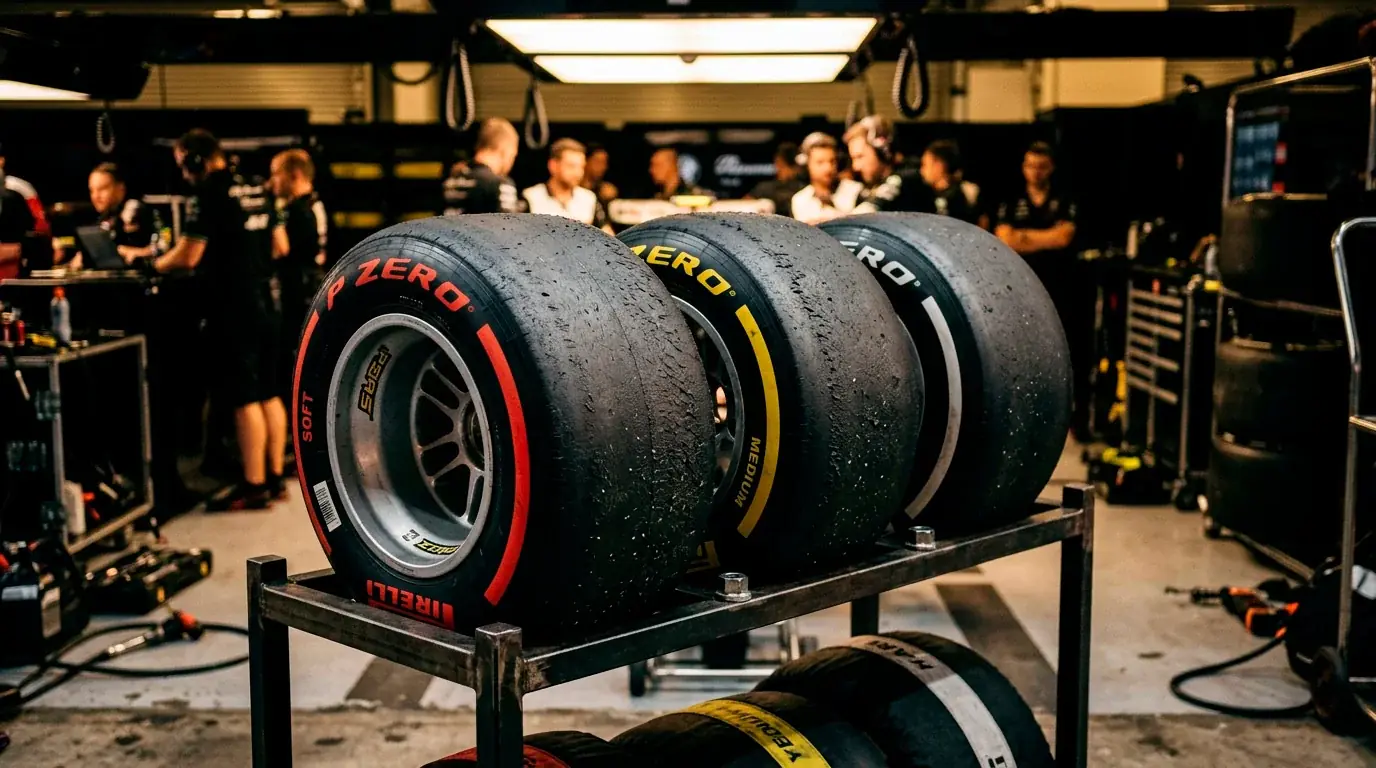
Tyre degradation is the subtler weather-adjacent variable. At circuits with high abrasion surfaces — Barcelona, Bahrain, Silverstone — tyre management separates the good strategists from the rest. A driver who preserves their tyres over a long stint can pit later, undercut rivals or extend into a different strategy window entirely. Practice session data gives clues here: long runs on Friday afternoon reveal degradation rates by compound, and those numbers feed directly into race-day strategy predictions.
I track three weather-related data points before every race weekend: the forecast probability of rain during qualifying and race, the historical weather patterns at that circuit (some venues are significantly more rain-prone than others), and the wind conditions that can affect car balance and straight-line speed. When the rain probability exceeds 40% for race day, I look specifically for value on midfield drivers with strong wet-weather records. The payoff when it does rain is typically large enough to offset the times when the clouds pass without a drop.
Variable conditions — a race that starts dry and transitions to wet, or vice versa — are the ultimate volatility multiplier. The decision to switch tyres at the right moment can swing ten positions in five laps. For bettors, these situations favour live positions over pre-race bets, because the value shifts in real time as the weather changes. Having capital reserved specifically for weather-disrupted races has consistently been one of the highest-returning elements of my season-long approach.
Seasonal Arcs: Early-Season Value vs Late-Season Certainty
The 2026 calendar has 24 races running from mid-March to early December. That is not one betting event — it is three distinct seasons with different strategic profiles, and treating them identically is a mistake I see repeated every year.
The opening phase — roughly races one through six — is the highest-uncertainty period. Teams are still understanding their cars, reliability is unproven, and the pecking order is unclear. This is where outright championship value is at its peak. F1’s global fanbase reached 827 million in 2025, up 63% since 2018, and that explosion of casual interest means early-season races attract heavy public betting on familiar names. The public backs the previous year’s champion by default, often without recognising that a regulation change can completely reset the competitive order. If you have done your homework on pre-season testing and the technical implications of the new rules, the early rounds are where your information edge is widest.
The middle phase — races seven through sixteen — is where the development race kicks in. Teams bring upgrades, performance trajectories diverge, and the season narrative starts to crystallise. Outright odds shorten on the leaders and lengthen on the also-rans. This is the phase where I focus most of my race-weekend value betting, because the market has settled into a pattern that occasionally becomes complacent. A team on an upward trajectory after a successful upgrade package might still be priced at its pre-upgrade odds for a race or two before the market catches up.
The closing phase — races seventeen through twenty-four — is the tightest part of the calendar. Championship battles narrow to two or three contenders. Odds on race winners at the front become very short, and the bookmaker’s margin eats into any potential value. I shift my focus in this phase toward secondary markets: podium finishes, head-to-heads in the midfield, safety car props at street circuits, and partial cash-outs on any season-long positions I still hold. The closing phase rewards patience and position management over aggressive new bets.
The overarching principle across all three phases: the F1 season is a marathon, not a sprint. The punters who come out ahead are the ones who match their strategy to the calendar’s natural rhythm rather than applying the same approach to every race weekend regardless of context. 43% of F1 fans are now under 35, and this data-literate audience is increasingly approaching the sport — and its betting markets — with exactly this kind of structured, seasonal thinking.
See also: protect your stakes with our F1 betting bankroll management tips.
Questions About F1 Betting Strategy
How much of an F1 betting bankroll should go on a single race?
A sensible ceiling is 5-10% of your total season bankroll on any single race weekend, spread across multiple positions rather than one large bet. For individual market selections, 1-3% of the bankroll per bet keeps variance manageable across a 24-race calendar. The key is preserving enough capital to act when genuine value appears later in the season.
Do qualifying results reliably predict race outcomes for betting?
Qualifying and race results are correlated, but the strength of that correlation varies dramatically by circuit. At low-overtaking venues like Monaco, qualifying position is highly predictive. At high-degradation circuits with long straights, the qualifying-to-race gap widens considerably. Tracking each driver’s average position gain or loss from grid slot to finish across different circuit types gives you a much better predictive tool than raw qualifying position alone.
Are F1 accumulators worth the risk?
F1 accas can deliver value if built around correlated legs — selections that depend on similar underlying outcomes. Random multi-leg accas across unrelated markets tend to have negative expected value because the compounding probability of failure outweighs the inflated odds. Limiting accas to three or four legs and constructing them around a coherent race narrative keeps the risk-reward balance reasonable.
How does weather affect F1 betting odds on race day?
Rain narrows the performance gap between top and midfield teams, making upsets more likely. When wet weather is forecast, odds on frontrunners should lengthen and midfield prices should shorten — but the market often adjusts too slowly, creating temporary value windows on drivers with strong wet-weather records. Checking forecasts and historical weather patterns at each circuit before placing pre-race bets is one of the simplest edges available.
Prepared by the Betting f1 editorial staff.