F1 Betting Bankroll Management Across a 24-Race Season
 Available in US
The Bankroll Is the Bet You Make on Yourself
I blew my entire F1 betting bankroll in 2020 by the seventh race of the season. Not because my picks were terrible — my strike rate was actually decent — but because I had no system for how much to stake on each race, and a three-weekend losing run drained what had felt like a comfortable cushion. That experience reshaped how I approach every season since. A bankroll is not just money set aside for betting. It is the mechanism that keeps you in the game long enough for your edge to compound.
F1 presents a unique bankroll challenge compared to football or horse racing. A Premier League season runs 38 matchweeks with ten games each — hundreds of betting opportunities spread across nine months. F1 gives you 24 race weekends, each with a handful of genuinely actionable markets. The density is lower, the stakes per event feel higher, and the temptation to overbet on a “strong conviction” race is constant. Managing that temptation is the entire game.
See also: return to betting f1 for more F1 betting strategies.
Setting the Baseline: How Much Is Enough for a Season
The right bankroll size depends on your betting style, but the principle is universal: it should be an amount you can lose entirely without affecting your life. I stress this because the UK Gambling Commission reports that around 1.4 million adults in Britain experience problems with gambling, and the line between recreational and harmful betting is often invisible until you have crossed it. Set your bankroll before the season starts, fund it once, and do not top it up if it depletes.
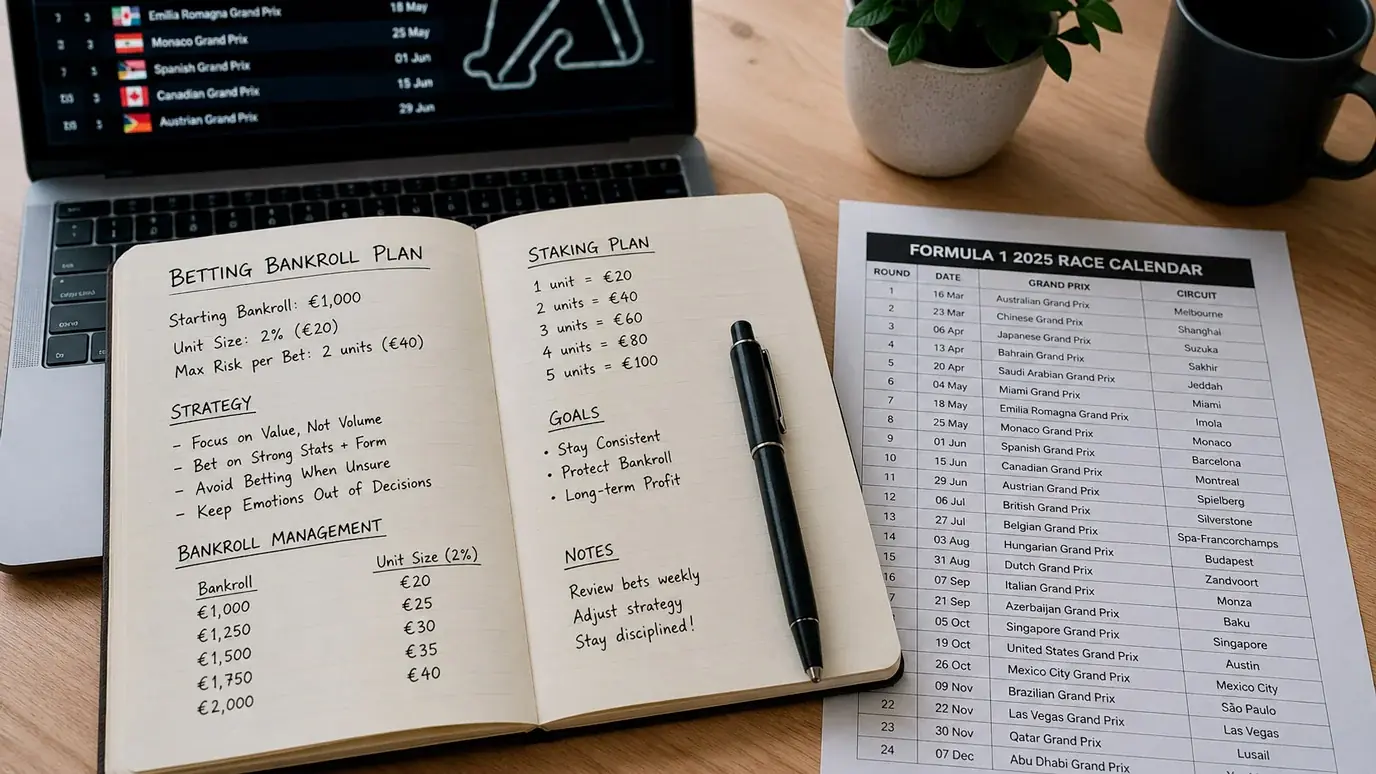
For a bettor who places three to five wagers per race weekend at average stakes, I recommend a starting bankroll that covers at least 100 individual bets at your planned unit size. If your standard bet is five pounds, a 500-pound season bankroll gives you the runway to absorb a twelve-race losing streak — which sounds extreme but is statistically plausible at a 30% strike rate across the kinds of odds F1 markets typically offer.
The 24-race calendar means you need to pace that bankroll. I divide mine into monthly allocations based on the race density in each month. March might have two races; October might have four. The monthly slice matches the opportunity set, preventing the common trap of spending too heavily early in the season when enthusiasm is highest and running dry when the championship reaches its decisive final third.
Unit Sizing and the Flat-Stake Discipline
Flat staking — betting the same unit on every wager — is the approach I recommend for anyone who has not yet built a multi-season track record. It is boring, it feels constraining when you have a strong opinion, and it works. The reason is variance management. F1 results carry inherent unpredictability — a loose drain cover in Las Vegas or a freak rain shower in Interlagos can invalidate the most careful analysis. Flat staking ensures that no single piece of bad luck disproportionately damages your bankroll.
My standard unit is 2% of my starting bankroll. On a 500-pound bank, that is ten pounds per bet. I allow myself a “strong conviction” tier at 3% for situations where the data alignment is exceptional — a frontrunner taking a grid penalty at a high-overtaking circuit, for example, where the market has clearly overreacted. But the strong conviction tier has a hard cap: no more than three uses per month. Without that cap, every bet starts feeling like a strong conviction, and the discipline evaporates.
Some experienced bettors use proportional staking, where the unit size adjusts as the bankroll grows or shrinks — 2% of the current balance rather than the starting balance. This method has mathematical elegance, but it also means your stakes shrink during losing runs precisely when you might want to maintain position sizing to recover. I tried it for a season and found the psychological effect discouraging. Flat staking from the starting balance keeps the numbers simple and the mindset steady.
Allocating Across Market Types
Not every F1 market deserves the same slice of your bankroll. I split my season allocation roughly as follows: 40% on race-weekend singles (race winner, podium, head-to-head), 25% on qualifying markets, 20% on season-long specials and outrights, and 15% on speculative plays like bet builders and prop bets. The percentages reflect expected hit rates and variance profiles rather than personal preference.
Race-weekend singles hit often enough to provide a steady return baseline. Qualifying markets are my highest-conviction area because the compressed format reduces variables. Season-long specials tie up capital for months, so a smaller allocation prevents liquidity problems. Speculative plays carry the lowest expected hit rate but the highest potential individual payouts, and keeping them to 15% ensures a cold streak in bet builders does not ripple through the rest of the bankroll.
The F1 fanbase’s expansion to 827 million people has driven bookmakers to offer ever more markets per race weekend, and the temptation is to spread your bankroll across dozens of bets. Resist it. Dilution is the enemy of a managed bankroll. Five well-researched bets per weekend, properly sized, will outperform fifteen scattered wagers where each stake is too small to matter but the aggregate exposure is dangerously large.
Surviving the Mid-Season Grind
Every F1 season has a rhythm. The opening races carry excitement and fresh data. The mid-season — roughly races eight through sixteen — is where discipline is tested. The novelty has faded, the championship picture is taking shape, and the weekends blur together. This is when bankroll mistakes happen: chasing losses from the previous race, doubling up on a “sure thing” to recoup a bad month, or abandoning the allocation plan because it feels too conservative.
See also: stay compliant with our F1 betting UK regulation overview.
I combat mid-season drift with a fortnightly review. Every two weeks, I check my bankroll against the planned depletion curve — am I ahead, behind, or on track? If I am ahead, I continue as normal. If I am behind by more than 15%, I reduce my unit size for the next two races to slow the bleed. If I am behind by more than 30%, I take a weekend off entirely. Stepping away is not failure — it is the bankroll management equivalent of a pit stop. You come back with fresh tyres and a clearer head.
The back end of the season, from October through December, is where a well-managed bankroll pays its biggest dividends. Championship battles tighten, team performance stabilises, and the data set you have accumulated over eighteen races gives you a genuine informational advantage. The bettors who blew their bankroll in the summer are out of the game. You are still in it, with capital to deploy and a strategy sharpened by months of observation.
How much should a beginner set aside for an F1 betting bankroll?
A practical starting point is an amount that covers at least 100 bets at your intended unit stake, which you can afford to lose entirely. For someone betting five pounds per wager, that means a 500-pound season bankroll. The critical rule is to fund it once at the start of the season and not add more if it runs down.
Should I increase my stakes when I am on a winning streak?
Flat staking — keeping the same unit size regardless of results — is the safest approach for most bettors. If you want to scale up, do so gradually and only after a sustained positive track record across multiple race weekends, not in response to a single good result.
What happens if my bankroll runs out mid-season?
If your bankroll depletes before the season ends, the disciplined move is to stop betting until the next season and analyse what went wrong. Topping up a depleted bankroll often leads to escalating stakes and chasing behaviour, which compounds the problem rather than solving it.
Published by the Betting f1 team.