F1 Data Tools and Timing Feeds That Sharpen Betting Decisions
 Available in US
F1 Drowns You in Data — the Trick Is Knowing What to Drink
Formula 1 generates more live telemetry than any other major sport. During a Grand Prix, each car transmits over 1,100 data channels at a rate of roughly 1.5 gigabytes per race. Tyre temperatures, brake pressures, throttle traces, DRS activations, fuel loads, energy recovery — the stream is relentless. For the average viewer, this is background noise. For a bettor willing to process even a fraction of it, this data transforms race-weekend markets from guesswork into analysis.
I started using data tools for F1 betting in 2019, and the improvement in my strike rate was immediate and measurable. Not because the tools gave me secret information — most of the data I use is publicly accessible — but because they imposed a discipline on my decision-making. When you are forced to look at sector times and tyre degradation curves before placing a bet, you stop backing drivers based on how you feel about their qualifying interview.
Free Tools That Every F1 Bettor Should Use
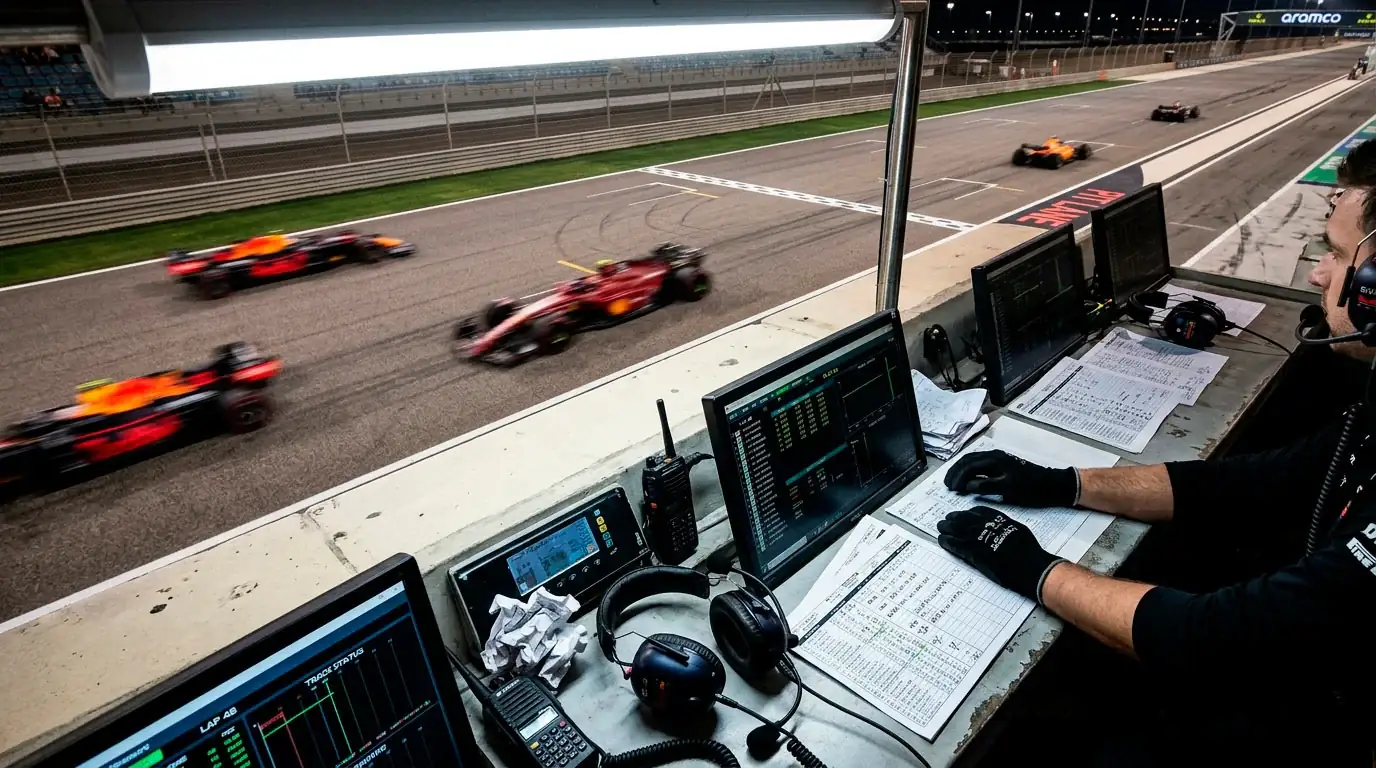
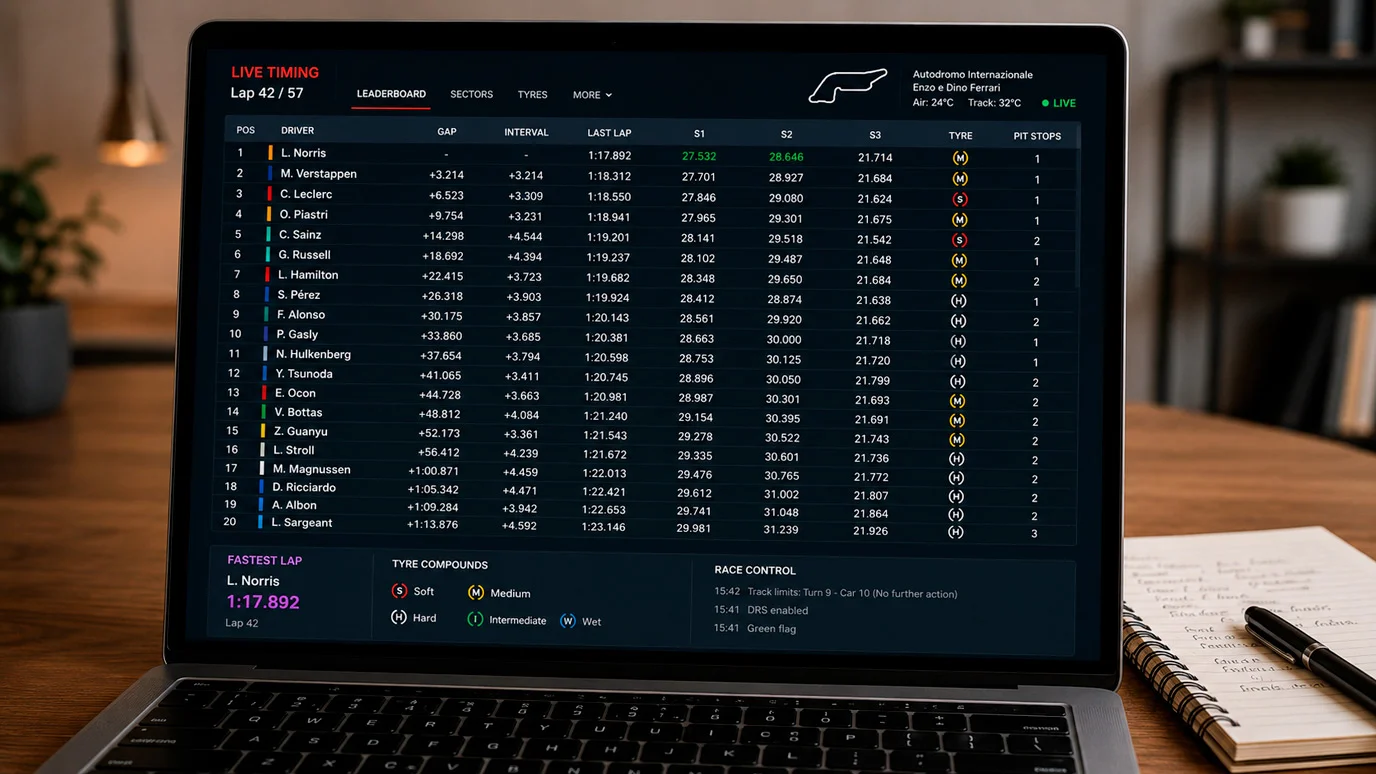
The official F1 timing screen, available through the F1 app and website, is the baseline. It provides live sector times, speed traps, gap data, and tyre compound information during every session. During practice, this is where you identify genuine pace versus low-fuel glory runs. A driver who tops FP1 but only on a soft compound with low fuel is not necessarily the weekend favourite — a driver who posts the third-fastest time on mediums with a heavier fuel load might be the better bet.
Beyond the official feed, the open-source FastF1 Python library pulls timing data from the F1 API and makes it available for analysis. If you can write basic code — or even follow a tutorial — FastF1 lets you plot tyre degradation curves, compare qualifying sector times, and visualise race pace over stint lengths. I run a standard set of queries after every practice and qualifying session: long-run pace by compound, stint degradation rate, and sector-by-sector comparison of the top six. The output takes fifteen minutes to generate and gives me a data-backed view of the field before the odds settle.
For those without coding skills, several community-run sites compile F1 timing data into accessible dashboards and charts. These free resources aggregate historical results, circuit-specific statistics, and qualifying-to-race conversion data that would take hours to compile manually. The correlation between F1 viewership and betting volume sits at roughly 0.85, which tells you the market moves with eyeballs — and eyeballs are emotional. Data tools let you see past the emotion.
Paid Platforms and What They Add
The free tools cover 80% of what a serious F1 bettor needs. The paid platforms fill in the remaining 20% with speed, depth, and historical context. Services that offer real-time telemetry overlays let you watch qualifying with data streaming alongside the broadcast, so you can see exactly where a driver gained or lost time before the session even ends. That speed advantage matters in live markets where odds shift rapidly.
Historical databases are the other major value-add. Platforms that maintain multi-season archives of lap times, weather data, tyre strategies, and results by circuit allow you to run comparisons that free tools cannot support. How does a driver’s wet-weather pace at Spa compare across three seasons? What is the average safety car deployment time at Jeddah over the past four years? These questions have concrete answers, and having them before race day gives you a framework for evaluating the odds rather than reacting to them.
The investment in paid tools makes sense only if your betting volume justifies the subscription cost. For a bettor staking 20 to 30 pounds per race weekend, a 150-pound annual subscription to a data platform needs to improve your returns by at least that amount to break even. For higher-volume bettors, the maths tilts decisively in favour of the tools. I view the cost the same way a team views spending on a car upgrade — it only matters if it translates into performance on track.
Timing Feeds During Live Sessions: Where Speed Wins
Live timing data is the sharpest weapon in the F1 bettor’s toolkit, and it matters most during qualifying and the opening laps of the race. Qualifying unfolds in real time, and the gap between a driver setting a sector-one personal best and the market reacting to it can be several seconds — an eternity in live betting. If you are watching the timing screen and see a frontrunner abort a lap due to traffic while the market has not yet adjusted, you have a window to back them at odds that overstate the probability of a poor qualifying result.
During the race, timing feeds reveal pit-stop windows before the broadcast commentary catches up. When a driver’s lap times start climbing by three or four tenths per lap, their tyres are degrading and a pit stop is imminent. If the market is pricing that driver’s position based on their current track position without accounting for the impending stop, you can take a position in the head-to-head or finishing-position market before the odds adjust. F1 represents just 0.4% of the global betting handle, and that small market share means the live odds are less efficiently priced than in football or tennis, where the volume of informed money keeps prices tight.
The key discipline with live timing is not to chase every fluctuation. A single slow sector might mean a driver hit traffic, not that their pace has collapsed. I use a three-lap rolling average to filter noise from signal — if the degradation trend holds across three consecutive laps, it is real. If it is a single blip, I ignore it and wait for confirmation.
Integrating Data Into a Pre-Race Betting Routine
The tools are only as good as the process they feed into. I follow a structured pre-race routine that starts with FP1 on Friday and concludes thirty minutes before lights out on Sunday. After each practice session, I pull the timing data, run my standard queries, and update a simple spreadsheet that ranks the top ten by long-run pace, single-lap pace, and degradation rate. After qualifying, I add the grid positions and calculate position-change probabilities based on historical circuit data.
On Sunday morning, I review the weather forecast, check for any overnight penalty announcements, and compare my spreadsheet rankings against the bookmaker’s odds. Discrepancies between my data-driven rankings and the market prices are where I place my bets. The process takes about an hour across the weekend — less time than most people spend debating predictions on social media — and it converts the overwhelming data stream into three to five actionable wagers.
For a broader perspective on how to turn data into a structured approach, the principles of F1 betting strategy provide the framework within which these tools operate. Data without strategy is just noise. Strategy without data is just opinion. The combination is where consistent returns live.
Do I need to know how to code to use F1 data tools for betting?
No. The official F1 timing screen and several community-built dashboards provide accessible data without any technical skills. Coding ability — particularly basic Python — opens up more advanced analysis through libraries like FastF1, but it is not a prerequisite for data-informed betting.
How far back should historical data go for meaningful F1 betting analysis?
Three to five seasons provides a useful baseline for circuit-specific patterns like safety car frequency and qualifying-to-race conversion rates. Going further back introduces regulation-change noise that can distort the data, as car performance characteristics shift significantly with each major rule cycle.
Written by the editors at Betting f1.