F1 Live Betting: How In-Play Markets Move Lap by Lap
 Available in US
- What Makes Formula 1 Unique for In-Play Betting
- How Live F1 Odds Move: Data Feeds, Gaps and Pit Windows
- Key In-Play Markets During an F1 Grand Prix
- Telemetry, ALT Sports Data and the Future of Real-Time Odds
- How Overtake Mode and Active Aero Change In-Play Dynamics in 2026
- Cash-Out Timing: When to Lock In Profit Mid-Race
- Questions About F1 Live Betting
What Makes Formula 1 Unique for In-Play Betting
The moment that sold me on live F1 betting was a wet qualifying session at Spa. I had backed a midfield driver for a top-six grid position at decent pre-weekend odds. Then rain hit in Q3. The live odds on half the field went haywire, and I watched the market reprice everything I thought I knew about that weekend within the space of three minutes. That speed — the raw volatility of a sport where conditions change by the corner — is what makes F1 unlike any other live betting product.
Formula 1 generates more usable real-time data than almost any sport on the planet: tyre temperatures, fuel loads, sector times to the thousandth of a second, radio messages, pit stop windows, energy deployment modes. Jonny Haworth, F1’s Director of Commercial Partnerships, put it bluntly when he pointed out that F1 makes up just 0.4% of the global betting handle, which he called “pretty crazy for a sport that has low latency data at a high volume which is what drives betting.” He is right. The data infrastructure for in-play F1 betting is ahead of the product — the markets are catching up to the information, not the other way around.
Compare that to football, where the core data points are goals, possession and shots on target — a handful of variables that change infrequently. An F1 race produces hundreds of data points every lap across twenty cars. Sector times update every fifteen to twenty seconds per driver. Tyre compound choices create strategic forks that a football match simply does not have. The result is a live betting environment where the odds surface is constantly shifting, and where a bettor who reads the race intelligently can identify mispricings that persist for laps at a time before the market corrects.
This guide covers how live F1 odds actually move during a race, what markets are available in-play, how emerging data partnerships are reshaping real-time pricing, and what the 2026 rule changes — particularly Overtake Mode and active aerodynamics — mean for the next generation of in-play markets.
See also: head to betting f1 for essential F1 wagering tools.
How Live F1 Odds Move: Data Feeds, Gaps and Pit Windows
Most sports have a clock. F1 has laps, pit windows, tyre degradation curves and weather radar — none of which follow a predictable schedule. That makes the mechanics of live odds movement fundamentally different from what you would see in a football match or tennis set.
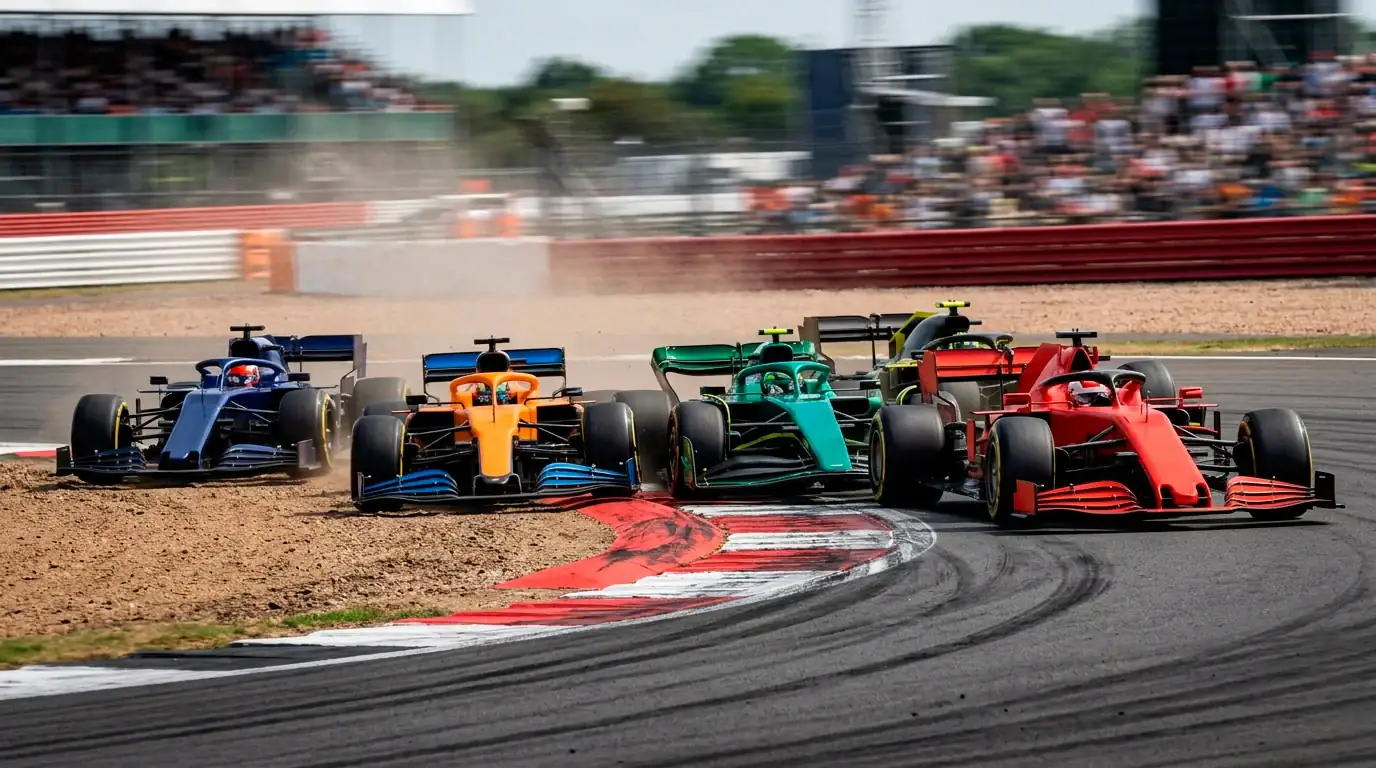
Pre-race, odds are set based on qualifying results, practice pace, historical circuit data and team form. The grid is locked, and the market has priced in what it knows. At lights out, the first corner reshuffles everything. A botched start, contact in the pack, or a jump into a gap nobody expected can move the race winner odds by double-digit percentage points within ten seconds. I have seen a driver go from 5.00 decimal odds to 2.50 between the start and Turn 3 because two rivals tangled and dropped down the order.
After the opening-lap chaos settles, live odds enter what I call the “degradation phase.” This is where tyre wear, fuel load and relative pace data start feeding into the models. The correlation between F1 viewership and betting volume sits at r=0.85 over the past five seasons, and a big part of that is the rhythm of a Grand Prix: viewers watching the timing screens see the same sector deltas the odds compilers see. When a driver’s gap to the car ahead starts shrinking by two-tenths per lap, the in-play market notices — sometimes before the TV commentary does.
Pit windows are the biggest discrete events during a race. When a frontrunner pits, their in-play odds lengthen briefly (they are now behind the cars that have not stopped) and then shorten again as the undercut or overcut plays out. The gap between the pit stop and the recalculation of relative positions is where sharp in-play bettors make their moves. If you know a driver is on an aggressive one-stop strategy and the field is two-stopping, there is a brief window where the market has not fully accounted for the strategy differential.
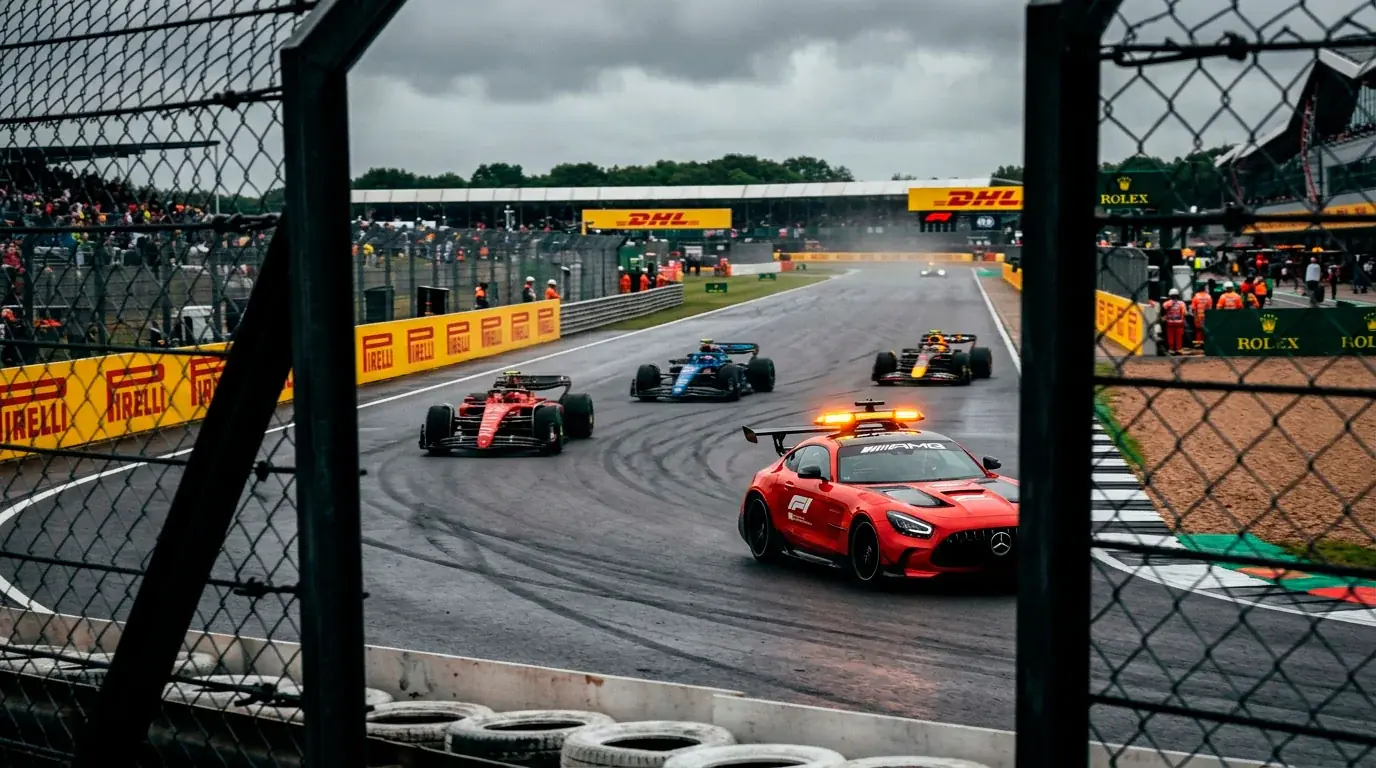
Safety car deployments are the nuclear option for live odds. A full safety car bunches the entire field, erases gaps that took twenty laps to build, and essentially restarts the race. In-play odds on race winner, podium and head-to-head markets all recalculate instantly. The flip side: during a safety car period, some bookmakers suspend in-play markets entirely, while others continue to offer odds at wider margins. Knowing your bookmaker’s policy before the race starts saves you from panicking when the yellow flags come out.
Rain is the final accelerant. A passing shower at Interlagos or Spa can swing odds more violently than anything else in sport. Wet-weather specialists suddenly become contenders, intermediate and full-wet tyre choices create strategic forks, and the grid order can invert within five laps. I keep a weather radar tab open during every race I bet on — it is the single most useful external data source for in-play decisions.
Key In-Play Markets During an F1 Grand Prix
Not every market stays open once the lights go out. Understanding which ones do — and how they behave in-play — is the difference between structured live betting and just gambling on impulse.
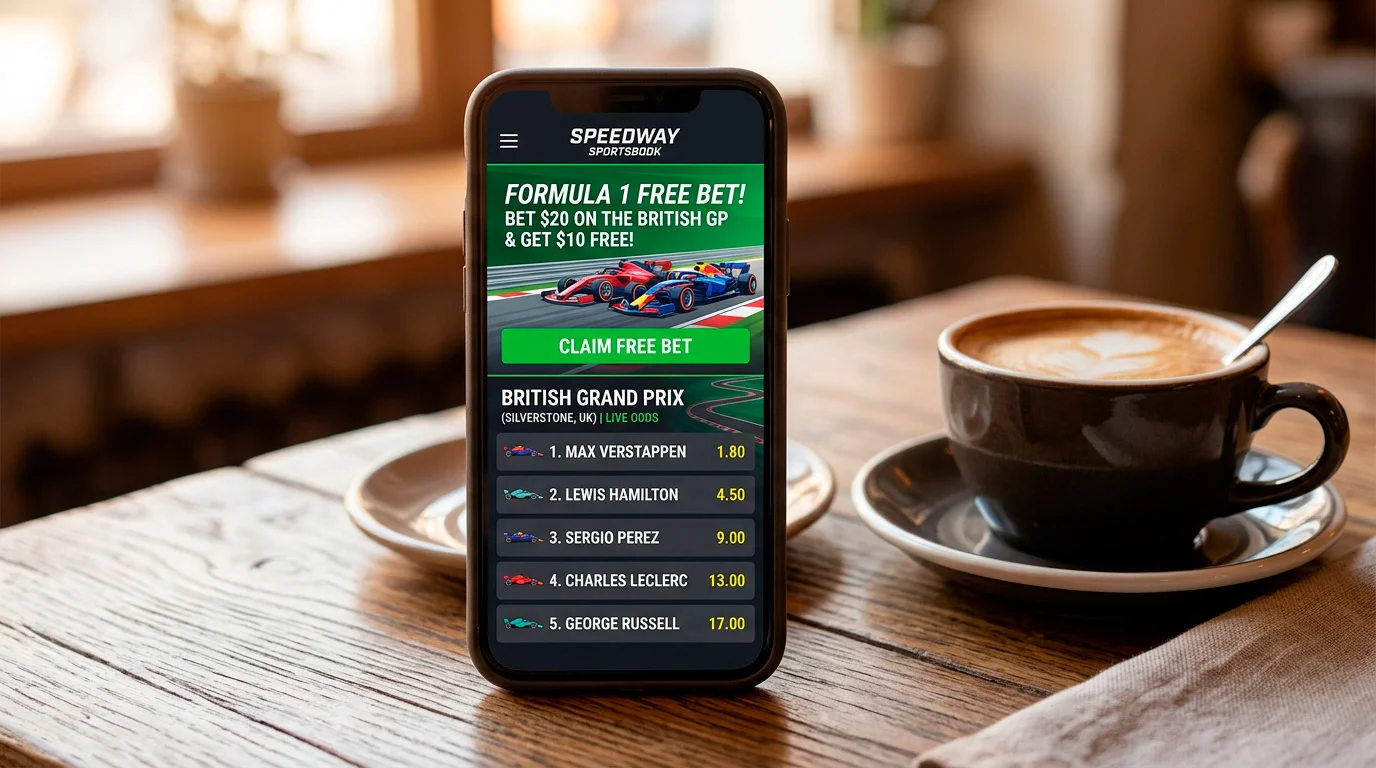
The race winner market is the flagship in-play product. It is available from lights out to the final laps, though odds tighten dramatically once the leader builds a comfortable gap. The value window is widest in the first stint and immediately after pit stops, when relative positions are still in flux. I tend to avoid race winner in-play bets after lap 40 of a 57-lap race unless something dramatic has happened — by that point, the odds rarely compensate for the remaining uncertainty.
Podium and top-six finish markets remain active throughout the race and often offer more interesting in-play angles than race winner. A driver running fifth who has fresher tyres than the cars ahead might drift to generous podium odds simply because the market focuses on current position rather than projected pace over the remaining laps. More than 30% of F1’s digital audience engages with betting content during race weekends, and much of that in-play activity clusters around these secondary position markets.
Head-to-head matchups are sometimes offered in-play, particularly teammate battles. These are compelling because a pit stop that drops one teammate behind the other can temporarily skew the odds even though the underlying pace difference has not changed. If you know Team A always runs staggered strategies for their two drivers, you can anticipate these temporary dislocations and exploit them.
Safety car yes/no is typically available in-play until one is deployed (or until the final laps when a deployment becomes unlikely). The odds shorten as the race progresses at incident-heavy circuits and lengthen at circuits where the first stint has passed cleanly. Fastest lap markets are occasionally available in-play, though liquidity tends to be thin because the outcome often depends on a single lap near the end of the race when a driver pits for fresh soft tyres.
One market I use more than most: next driver to retire. If you are watching the race and hear a radio message about a gearbox issue or see a driver nursing their car through slow corners, the retirement market can be slow to react. Television delay means the in-play odds sometimes lag behind what is actually happening on track by thirty seconds or more — an eternity in live betting terms.
Telemetry, ALT Sports Data and the Future of Real-Time Odds
I remember a conversation with a trading analyst at a mid-tier bookmaker a few years back. He admitted that their F1 in-play model was, in his words, “about three years behind where it should be” compared to football. The reason was simple: they did not have access to structured, real-time F1 data feeds. That is changing — fast.
F1’s partnership with ALT Sports Data represents a step change in how live betting products get built. ALT provides official, low-latency data feeds — sector times, tyre compound, pit stop durations, track position — directly to licensed operators. Before this, bookmakers were relying on broadcast data or third-party scrapers, both of which introduced delay and inaccuracy. Karol Corcoran, Managing Director of FanDuel Sportsbook, flagged this directly when discussing FanDuel’s appointment as F1’s first official betting operator: the platform is “built to turn real-time data into engaging betting opportunities for fans.”
For punters, the practical impact of better data feeds is tighter in-play odds and faster market updates. But it also means the edge from watching the race attentively is narrowing. When the bookmaker’s model ingests the same sector times you see on the timing screen, the information advantage of a knowledgeable viewer shrinks. The remaining edge moves to interpretation: understanding what the data means strategically rather than just reading the numbers. A two-tenth sector deficit might mean tyre degradation or it might mean the driver is managing energy for a later deployment — the data alone does not tell you which.
Timing screens available through F1’s official app and website are still the most accessible data source for UK bettors. They show live sector times, gaps to the car ahead, lap-by-lap pace, pit stop windows and tyre compound information. Radio messages, broadcast with a short delay, add qualitative context that no data feed captures — a driver complaining about understeer is information that moves the dial on tyre strategy predictions.
The future is heading toward prediction markets driven by machine learning models trained on telemetry data. F1 produces terabytes of sensor data per race that the teams use internally but that has never been available to the betting ecosystem. As official data partnerships expand, fragments of that telemetry will start reaching odds compilers, enabling markets that today’s models cannot price — tyre life remaining, energy recovery system state, brake temperature profiles. We are not there yet, but the trajectory is clear.
What this means practically for anyone live betting F1 right now: the edge is in the interpretation layer. Raw data is becoming commoditised. The punter who can look at sector times, listen to the radio, factor in tyre age and read the strategic context of a pit window simultaneously — that punter has a structural advantage over any model running on timing data alone. Live F1 betting rewards the kind of multi-variable pattern recognition that human judgment still does better than algorithms, at least for now.
How Overtake Mode and Active Aero Change In-Play Dynamics in 2026
Max Verstappen summed up the old energy management era with a frustration most drivers shared: the inputs a driver makes have a massive effect on the energy side of things, and that is “just not Formula One.” The 2026 regulations address this head-on, and the consequences for in-play betting are significant.
Overtake Mode is the centrepiece. Under the new rules, drivers have a manual override that delivers a burst of additional electrical energy from the hybrid power unit. It is explicitly designed to facilitate overtaking — a driver within DRS range and closing distance can deploy Overtake Mode for a limited number of activations per lap. The tactical question is not just whether to use it, but when: an early deployment to get alongside into a braking zone, or a late deployment to complete a pass on the straight? Each choice has consequences for the remaining energy budget.
For in-play bettors, Overtake Mode introduces a variable that has never existed in F1 markets before. When a driver has used their Overtake Mode allocation and the car behind has not, the balance of the battle shifts. Live odds on position-based markets should adjust to reflect energy state — but in the early races of 2026, the models will not have enough historical data to price this accurately. That gap between reality and model is where sharp live bettors will find value.
Active aerodynamics compound the effect. The 2026 cars feature adjustable aero elements that switch between high-downforce (X-mode) for corners and low-drag (Z-mode) for straights. The transition is not instantaneous, and how teams calibrate the switch points affects lap time in ways that are circuit-dependent. At a track like Monza with long straights, aggressive Z-mode usage pays dividends. At Monaco, it is almost irrelevant. In-play markets at different circuits will behave differently depending on how much active aero matters to the competitive order — another layer of complexity that rewards preparation.
The combined effect of Overtake Mode and active aero is that the 2026 races should produce more on-track position changes than recent seasons. More position changes mean more in-play odds movement, more settlement points for prop markets, and more opportunities for informed bettors to act on what they see. If the regulation changes deliver on their promise, 2026 will be the best season for F1 in-play betting since I started covering the sport.
Cash-Out Timing: When to Lock In Profit Mid-Race
Cash-out is the most emotionally loaded feature in live betting. I have taken profits too early and watched a driver go on to win at 8/1. I have held on too long and watched a mechanical failure wipe out a bet that was showing a 300% return twenty laps earlier. Neither experience teaches you much beyond the obvious: the maths of cash-out is not about emotion, it is about expected value at the moment of the decision.
Every cash-out offer is a price the bookmaker is willing to pay to close your bet. That price includes the bookmaker’s margin, so it is always slightly less than the theoretical fair value of your position. The question is whether the discount is worth paying for the certainty. If your driver is leading by twelve seconds with ten laps to go and a clean track, the cash-out offer will be high but the probability of full payout is also very high — the discount might not be worth it. If your driver is leading by two seconds with rain approaching and a safety car likely, the cash-out offer might be the smartest move available.
Partial cash-out is where the feature gets genuinely useful for live F1 betting. Instead of closing your entire position, you lock in a percentage of the profit and leave the rest running. I use partial cash-out most often during pit stop sequences. If my driver has just pitted and dropped behind the field, the cash-out value dips temporarily. Rather than panicking, I wait for the undercut to play out, and if it works, the cash-out value recovers or exceeds its pre-stop level — at which point I might lock in 50% and ride the rest.
Auto cash-out triggers are offered by some bookmakers: you set a target value and the system executes automatically if the cash-out reaches that figure. Useful during F1 races because odds move so quickly that a manual cash-out can be outdated by the time you press the button. The delay between requesting a cash-out and it being accepted — sometimes just a second or two — can coincide with a safety car deployment that changes the value entirely. Auto triggers remove that timing risk, though they also remove your ability to react to context.
The one rule I follow without exception: never cash out because you are anxious. Cash out because the expected value calculation has changed based on new information — a radio message about a problem, a weather shift, a strategic development you did not anticipate. If the only thing that has changed is your nerve, the maths has not moved, and neither should you.
See also: combine in-play bets with qualifying insights from our F1 qualifying betting guide.
There is a broader point here about the psychology of live F1 betting that connects to cash-out behaviour. A Grand Prix lasts roughly ninety minutes to two hours. That is a long time to sit with an open position and watch it fluctuate. Unlike a football half that takes forty-five minutes with a break, a race is continuous, and the emotional pressure builds without relief. The punters who handle live F1 betting best are the ones who treat the race as a series of discrete phases — opening stint, pit window, second stint, closing stint — and make cash-out decisions only at phase boundaries, not in the middle of them. That structure removes the worst impulse decisions and keeps the focus on information rather than anxiety.
Questions About F1 Live Betting
How quickly do F1 in-play odds update during a race?
At major UK bookmakers, in-play F1 odds update within seconds of significant on-track events — overtakes, pit stops, safety car deployments and retirements. However, there is always a brief delay between the event occurring and the odds adjusting, particularly for complex scenarios like multi-car incidents where the full picture takes a few moments to emerge. During stable phases of the race, odds drift gradually based on gap data and tyre degradation patterns.
Can you place live bets during a safety car or red flag period?
Policies vary by bookmaker. Some suspend all in-play markets the moment a safety car or red flag is deployed, reopening them at the restart. Others keep markets open during safety car periods but widen the margins significantly to account for the uncertainty around restart dynamics. Red flag periods almost always result in suspended markets until racing resumes. Always check your bookmaker’s specific terms before the race.
What data sources feed real-time F1 betting odds?
Bookmakers use a combination of official F1 timing data, broadcast feeds and increasingly structured data from partnerships like ALT Sports Data. Sector times, gap information, tyre compound data and pit stop durations all feed into in-play models. For punters, the F1 official app and live timing screen are the most accessible free data sources, supplemented by team radio messages on the broadcast.
Is cash-out available on all in-play F1 markets?
Not universally. Cash-out is most reliably available on race winner and podium markets. Some bookmakers extend it to head-to-head matchups and points finish markets, but niche props like safety car or fastest lap bets may not offer cash-out. Availability can also drop during high-volatility moments when the bookmaker’s system suspends cash-out recalculations. Check your bookmaker’s in-play interface before the race to confirm which markets support it.
Written by the editors at Betting f1.